Med info
Presbyopia: Treatment and Advanced Techniques in 2026


Presbyopia causes blurry near vision due to natural, age‑related changes in the eye’s crystalline lens, usually starting around age 40. It is a very common condition, nothing to be alarmed about, and can be managed easily in a way that fits your lifestyle.
Presbyopia is the main reason many middle‑aged adults start using reading glasses, multifocal contact lenses, or a combination of both to correct their vision, depending on what they’re most comfortable with.
In fact, many people first notice age‑related vision changes when they find themselves holding a book or phone at arm’s length to see the text clearly.
In this article, we’ll discuss the causes of presbyopia, how it differs from hyperopia (farsightedness), its symptoms, and the available treatment options.
Discover the latest laser techniques for presbyopia correction at the Eye Center in Al Batal Specialized Complex.
What Is Presbyopia?
Presbyopia is a vision condition in which the shape and flexibility of your eye’s natural crystalline lens gradually change. These changes make it harder to focus on nearby objects.
To see clearly, the cornea and the lens of the eye bend (refract) incoming light and focus it onto the retina. The lens is normally flexible and can change its shape when you look at something up close.
The circular muscle (ciliary muscle) surrounding the lens contracts, allowing the elastic lens to change its curvature and focal point.
As you get older, the lens loses elasticity and becomes stiffer. It can no longer change shape enough to focus at near distances. This condition is called presbyopia.
Presbyopia develops gradually, usually starting in the early to mid‑40s, and continues to progress until about age 65. When it appears before age 40, it is known as early‑onset presbyopia.
Anyone who starts having trouble focusing on small print or close objects, or needs to hold a book at arm’s length to read, should have a comprehensive eye exam to check for presbyopia. Glasses, contact lenses, or surgery can correct this condition.
Read more: Can laser eye surgery correct reading vision problems?
Symptoms of Presbyopia
Common symptoms of presbyopia include:
Causes of Presbyopia
Age‑related changes in your eyes cause presbyopia. For the first few decades of life, your eye’s lens is soft and flexible, and its shape changes easily as you shift your focus from distant to near objects. This allows light to be focused precisely on the retina so you can see clearly.
As you age, the lens becomes less flexible and can no longer adjust its shape enough to focus light properly. This leads to presbyopia symptoms that typically start in your 40s and stabilize by the mid‑60s.
To better understand presbyopia, it helps to know a bit about how vision works:
Your lenses continue to grow as your eyes age. New layers of lens fibers form over time, which increases the thickness of the lens and makes it less flexible. As a result, light can no longer be focused accurately on the retina, and your near vision becomes blurry.
Diagnosis of Presbyopia
Presbyopia is usually diagnosed during a comprehensive eye exam, which may include the following steps:
Medical History
Diagnostic Tools
Treatment of Presbyopia
Eyeglasses
Whether or not you already wear glasses for other vision problems, this is often the time to switch to lenses that are more comfortable for your eyes. Options include:
Contact Lenses
There are several types of contact lenses that can help you see better with presbyopia. You can visit Al Batal Specialized Complex in Jeddah for help choosing the most comfortable and effective option for your vision:
Surgical Options
The following three laser procedures can correct presbyopia using monovision (one eye corrected for distance and the other for near vision):

Advantages of the Eye Center at Al Batal Complex for Presbyopia Treatment
The Eye Center at Al Batal Complex typically has a team of ophthalmologists and optometrists who specialize in diagnosing and treating a wide range of eye conditions, including presbyopia. These professionals have in‑depth knowledge and experience in managing presbyopia and can offer customized treatment options based on each patient’s individual needs.
The Eye Center at Al Batal Complex is equipped with advanced diagnostic and therapeutic technologies. They can provide a full spectrum of presbyopia treatments, including prescription glasses, contact lenses, and surgical procedures. Al Batal Complex also keeps up with the latest developments in presbyopia management and offers access to innovative technologies and devices.
Al Batal Eye Center offers competitive pricing for presbyopia screening and evaluation, as well as for the different treatment options.
The complex provides comprehensive eye examinations that go beyond simple visual‑acuity testing. They can perform a range of tests to assess the overall health of your eyes and detect any underlying eye conditions. This thorough evaluation helps ensure an accurate diagnosis of presbyopia and helps rule out other potential eye problems.
Al Batal Complex also provides comprehensive follow‑up care to monitor how well the prescribed treatment is working and to address any concerns or complications that may arise. Regular checkups and adjustments can be scheduled to ensure optimal visual outcomes and long‑term satisfaction.
Tips to Help Prevent or Delay Eye Problems Related to Presbyopia
Although presbyopia itself is unavoidable, there are several steps you can take to support eye health and reduce your risk of other age‑related eye diseases.
Maintaining Eye Health
Reducing Eye Strain
Maintaining Overall Health
Frequently Asked Questions About Presbyopia
Presbyopia can be corrected with eyeglasses, contact lenses, or surgery.
Blurry vision at normal reading distance and hazy near vision are typical signs.
Presbyopia cannot be reversed and tends to worsen as we age. These vision changes usually stabilize around age 65.
Bifocal and progressive (multifocal) eyeglasses are the simplest and most common treatments for presbyopia.
In this condition, the eye has difficulty distinguishing between parallel and horizontal lines.
The goal of presbyopia correction is to compensate for your eyes’ reduced ability to focus on near objects. Treatment options include wearing corrective eyeglasses or contact lenses, undergoing refractive surgery, or having lens‑replacement surgery for presbyopia.
There are some natural approaches that may help support overall eye health:
Presbyopia may be more challenging to manage when a person has other medical conditions such as diabetes, multiple sclerosis, or cardiovascular disease.
Yes, single‑vision reading glasses can correct presbyopia for near tasks.
What type of lens is used to correct presbyopia?
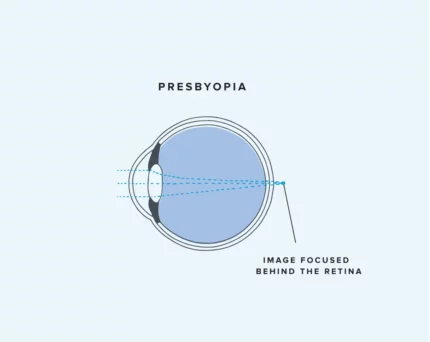
Convex (plus) lenses are used to correct presbyopia because, in this condition, the image of a near object is focused behind the retina. Convex lenses converge light rays and move the focal point forward onto the retina.
Read more: Does farsightedness improve in children?