Med info
What Is a Goiter? Everything You Need to Know About Thyroid Enlargement


A goiter is an abnormal enlargement of the thyroid gland. It has several possible causes and may or may not be associated with abnormal thyroid hormone levels. In most cases, it is treatable.
In a goiter, the thyroid gland becomes bigger than normal. The entire thyroid can enlarge, or one or more small lumps can develop inside it, called thyroid nodules.
The thyroid is a small, butterfly‑shaped endocrine gland located in your neck just below the Adam’s apple. It produces the hormones thyroxine (T4) and triiodothyronine (T3). These hormones play an important role in several body functions, including:
A goiter may be associated with abnormal thyroid hormone levels—either hyperthyroidism (overactive thyroid), hypothyroidism (underactive thyroid), or it can occur while thyroid hormone levels remain within the normal range.
You may also like: Hashimoto’s Disease | Causes, Symptoms, and Treatment of Hashimoto’s Thyroiditis
What Are the Types of Goiter?

Goiter can be classified in several different ways, including by how it grows and whether your thyroid hormone levels are abnormal.
Types of goiter based on how the gland is enlarged include:
– **Diffuse (simple) goiter:**
In this type, the entire thyroid gland enlarges uniformly and feels smooth to the touch.
– **Nodular goiter:**
This occurs when a solid or fluid‑filled lump, called a nodule, develops within the thyroid, giving the gland a lumpy feel.
– **Multinodular goiter:**
In this form, multiple nodules are present within the thyroid gland.
Nodules may be visible, or they may only be detected on physical examination or imaging tests.
Types of goiter based on thyroid hormone levels include:
Healthcare providers often combine these descriptors when classifying a specific case of goiter.
For example, a **toxic multinodular goiter** occurs when more than one nodule in the thyroid produces excess thyroid hormone.
You may also like: Ectropion | Definition, Treatment, Types, and Causes
Who Is Affected by Goiter?
Anyone can develop a goiter, but it is about four times more common in people assigned female at birth than in those assigned male at birth.
The risk of goiter also increases with age. It is more frequently seen after age 40. People with any of the following conditions are at higher risk of developing a goiter:
You are also more likely to develop a goiter if you have received radiation therapy to your head or neck, or if you have a family history of thyroid disease.
You may also be interested in: What Are the Treatment Options for Lacrimal Gland Tumors?
How Common Is Goiter?
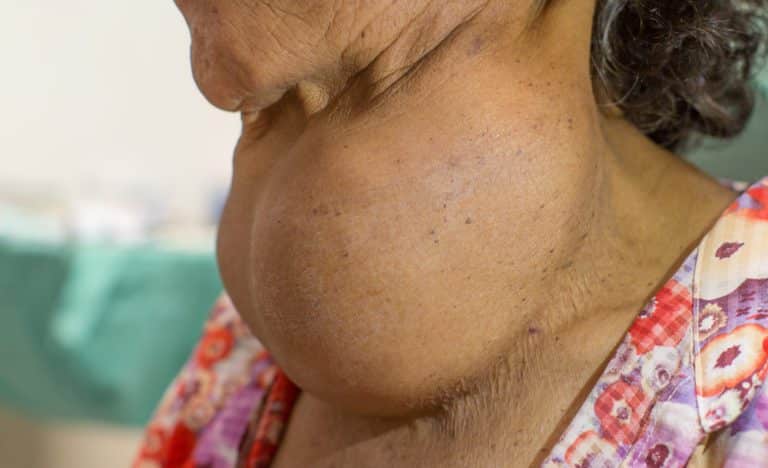
Goiter is relatively common, affecting about 5% of people in the United States. Worldwide, the most common cause of goiter is iodine deficiency, which is estimated to affect about 2.2 billion people.
The more severe the iodine deficiency in a population, the more likely individuals are to develop a goiter.
What Are the Symptoms of Goiter?
The size of a goiter can range from very small and barely noticeable to very large. Most goiters are not painful, but if the underlying cause is thyroiditis (thyroid inflammation), there may be pain or tenderness.
The main symptoms of goiter include:
Some people with goiter also have hyperthyroidism. Symptoms of hyperthyroidism may include:
In addition, some people with goiter have hypothyroidism. Symptoms of hypothyroidism may include:
What Causes Goiter?
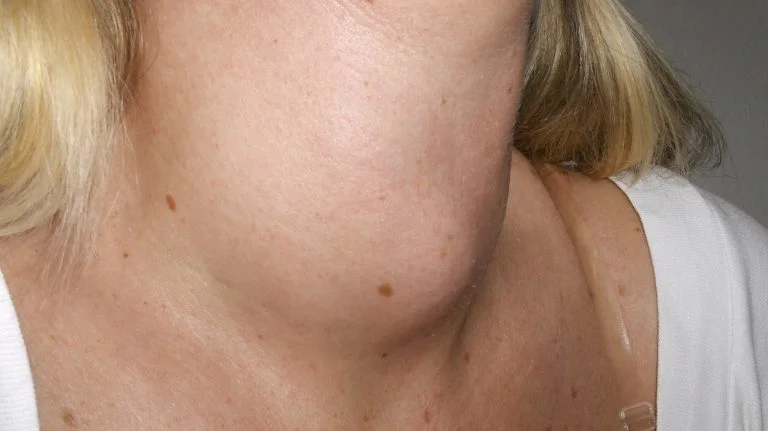
A goiter is usually a compensatory response of thyroid cells to any process that interferes with normal thyroid hormone production. While iodine deficiency is the most common cause worldwide, many other conditions can lead to goiter.
Common causes of goiter include:
Iodine Deficiency
The thyroid gland needs iodine to produce thyroid hormones. If you do not get enough iodine in your diet, the thyroid tries to compensate by growing larger and forming more cells in an effort to produce enough hormone.
Although this is the leading cause of goiter globally, it is uncommon in the United States. You can usually get sufficient iodine through your diet by consuming seafood, dairy products, and iodized table salt.
Routine iodine supplements are not recommended for most people and may have unintended negative effects on your health.
Graves’ Disease
Graves’ disease is an autoimmune disorder in which your immune system attacks the thyroid gland, stimulating it to grow larger. Graves’ disease also causes hyperthyroidism, which requires medical treatment.
Hashimoto’s Disease
Hashimoto’s thyroiditis is an autoimmune disease that causes chronic inflammation of the thyroid. Some people with Hashimoto’s develop a compensatory enlargement of the thyroid gland.
This type of goiter often improves on its own over time. Some patients with Hashimoto’s disease need thyroid hormone replacement therapy.
**Thyroid cancer:**
Thyroid cancer can also present with an enlarged thyroid or a focal mass within the gland.
Pregnancy
During pregnancy, the hormone human chorionic gonadotropin (hCG) can stimulate the thyroid gland and cause it to enlarge slightly.
Thyroiditis
Inflammation of the thyroid itself (thyroiditis) can lead to enlargement of the gland. This can occur for several reasons.
In many cases, an intermittent or sporadic goiter has no clearly identifiable cause. However, certain medications can contribute to this type of goiter. For example, lithium—used to treat certain psychiatric conditions and some other medical problems—can cause thyroid enlargement in some patients.
Diagnosis and Testing for Goiter
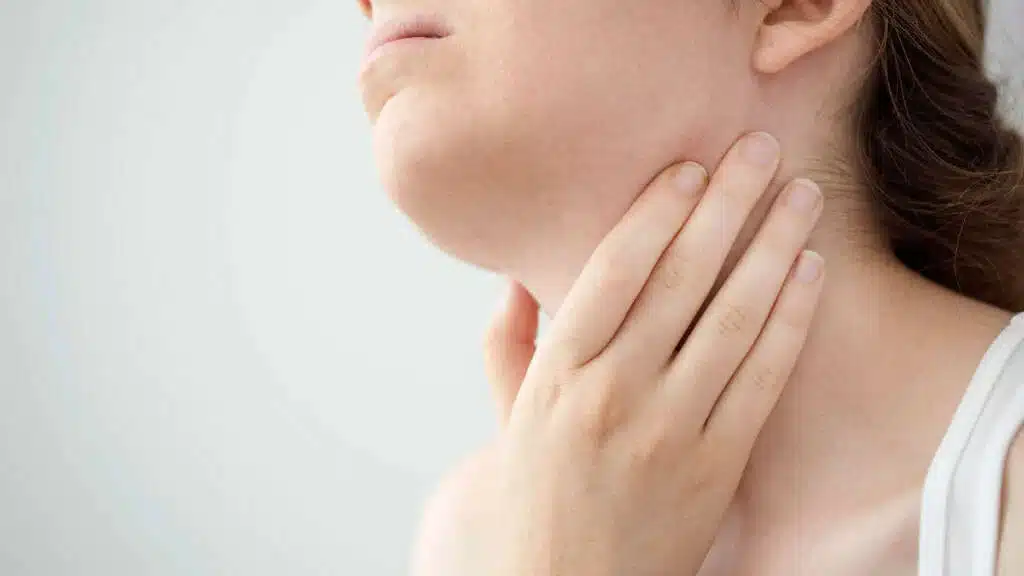
Doctors often first suspect a goiter during a physical exam when they feel an enlarged thyroid in your neck. However, the presence of a goiter simply indicates that there is a thyroid problem; further evaluation is needed to determine the exact cause.
Your doctor may use several tests to diagnose and assess a goiter, including:
Physical Examination
Your provider may gently feel (palpate) the front of your neck to determine whether the thyroid is enlarged and to check for nodules or tenderness.
Thyroid Blood Tests
These blood tests measure levels of thyroid hormones (such as T4 and T3) and thyroid‑stimulating hormone (TSH) to determine whether the thyroid is functioning normally, overactive, or underactive.
Antibody Testing
This blood test looks for specific thyroid antibodies that are present in certain types of goiter, especially autoimmune thyroid diseases. Antibodies are proteins made by white blood cells that help defend the body against infections and other perceived threats, such as viruses.
Thyroid Ultrasound
Thyroid ultrasound uses high‑frequency sound waves to create images or video of the thyroid gland. This allows your doctor to evaluate the size of the gland and determine whether nodules are present, as well as their characteristics.
Biopsy (Fine‑Needle Aspiration)
A biopsy involves removing a small sample of thyroid tissue or cells for examination under a microscope. A thyroid biopsy is usually recommended if there are large or suspicious nodules in the gland, primarily to rule out thyroid cancer.
Thyroid Scan and Uptake Test
This nuclear medicine test provides information about the size, shape, and function of the thyroid gland. A small amount of radioactive material is given (usually orally or by injection), and a special camera creates images of the thyroid on a computer screen.
Doctors do not order this test routinely; it is reserved for specific clinical situations where the functional information it provides is particularly useful.
CT Scan or MRI of the Thyroid
If the goiter is very large or extends down into the chest, a CT (computed tomography) scan or MRI (magnetic resonance imaging) may be used to measure the size and extent of the enlargement and to see if it is compressing nearby structures such as the trachea (windpipe) or esophagus.
You may also like: Eyelid Retraction Surgery | Causes and Treatment

Finally, in Saudi Arabia, Batal Specialist Complex is considered one of the leading and most advanced medical centers in the field of eye care and eye disease treatment. Its reputation continues to grow thanks to the strong track record of its physicians and its use of state‑of‑the‑art diagnostic and treatment technologies.
If you are experiencing any eye problem, do not hesitate to book an appointment at Batal Specialist Complex to receive top‑quality medical advice and care from an experienced ophthalmologist at the center.