
Med info
Hyperopia (Farsightedness) | What It Is, Causes, and Treatment

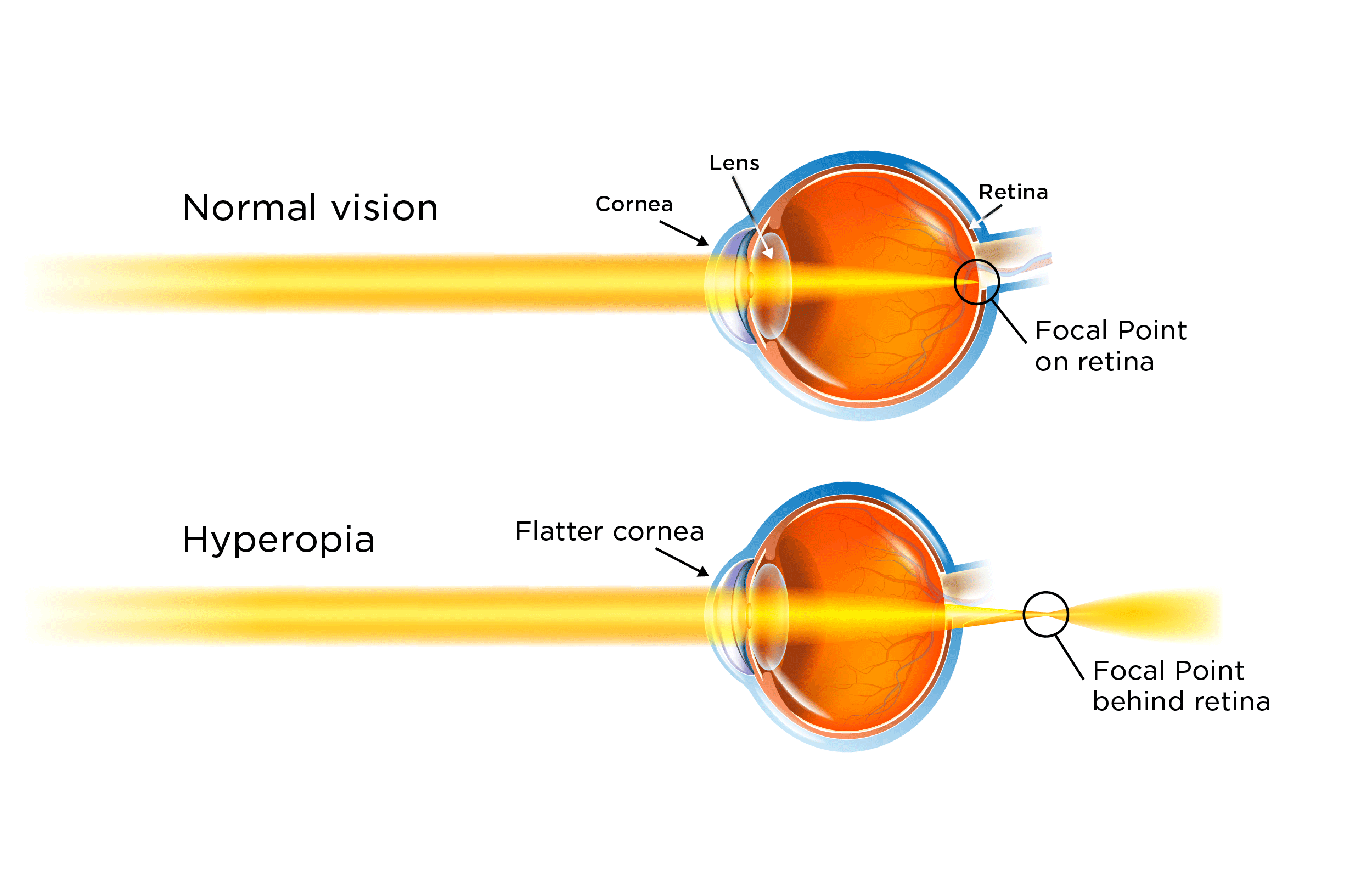
Hyperopia (farsightedness) is a refractive error that makes nearby objects look blurry. It occurs when the shape of the eye focuses incoming light behind the retina (the light‑sensitive tissue layer at the back of the eye) instead of directly on it. In this article, we explain everything you need to know about hyperopia.
Read also: Glaucoma Surgery at Batal Specialized Medical Complex
What Is Hyperopia?
Hyperopia (also called farsightedness or hypermetropia) is a refractive error that happens when the eye does not bend (refract) light properly. In general, a farsighted person can see distant objects clearly, but nearby objects appear blurry.
However, people experience hyperopia differently. Some may not notice any vision problems at all, especially when they are young. For others with more severe hyperopia, vision can be blurry at any distance—both near and far.
Put simply, hyperopia means you see distant objects more clearly than close ones. Your eyes are able to focus better on far objects than on near objects. Children with mild to moderate hyperopia may be able to see both near and far without glasses, because the eye muscles and the lens inside the eye can compensate and overcome the farsightedness by focusing harder.
Read also: Vision Correction Offers at Batal Specialized Medical Complex
What Causes Hyperopia?
To see clearly, light rays must pass through the front of the eye (the cornea and the lens). The cornea and lens work together to bend (refract) the light so that it focuses precisely on the back layer of the eye called the retina. The retina then sends signals to the brain, allowing you to see.
In hyperopia, the shape of the eye prevents light from bending correctly, so light focuses behind the retina rather than on it. For example, your eye may be shorter than normal from front to back, or the cornea at the front of the eye may be too flat.
As a result, light rays focus behind the retina. Typically this means that distant objects look clear, while close objects look blurry. If one parent is farsighted, their child is at higher risk of being farsighted as well.
However, a parent does not have to be farsighted for their child to develop hyperopia. Multiple factors likely contribute, and genetics are only one part of the picture.
Most children naturally have some degree of hyperopia, but they don’t necessarily have blurry vision. With mild hyperopia, most children see clearly both near and far. As they grow, the eye becomes longer, and mild hyperopia often decreases or disappears on its own.
Read also: Corneal Transplant Surgery – Everything You Need to Know
Hyperopia in Children
Hyperopia occurs when light is focused behind the retina instead of directly on it. This may be due to a shorter‑than‑normal eyeball or an insufficiently curved (too flat) cornea. According to the American Academy of Ophthalmology (AAO), most children are farsighted because their eyes are not yet fully developed.
However, most children’s eyes are able to compensate and adapt to mild hyperopia. Their eyes can bend incoming light in a way that allows it to focus on the retina, increasing clarity and eliminating blurred vision.
Mild hyperopia in children is very common and usually does not cause problems, because children can accommodate it. In general, they can see clearly both up close and at a distance. As children grow, their eyes lengthen, and hyperopia may improve on its own.
Refractive errors such as myopia (nearsightedness) and hyperopia (farsightedness) are among the most common causes of visual impairment worldwide. Hyperopia has a strong hereditary component. Twin and genetic studies show that genes account for at least about half of the risk—often more. This means that if one biological parent has hyperopia, it is very likely that their child will also be farsighted.
Read also: Intraocular Lens Implantation – What You Need to Know
Symptoms of Hyperopia
Signs and symptoms may include:
– Blurry vision at near distances (and sometimes at all distances in more severe cases)
– Eye strain or a burning sensation in the eyes, especially with near work
– Headaches after reading, using a computer, or doing close‑up tasks
– Squinting to see clearly
– Eye fatigue
Most children with hyperopia do not show obvious symptoms. This is due to the flexibility of the lens inside a child’s eye, which makes accommodation (shifting focus between distances) easier and allows them to overcome mild hyperopia.
Read also: Cornea and Its Problems | Common Corneal Disorders
Treatment for Hyperopia
Hyperopia can be easily corrected and treated with eyeglasses or contact lenses. These lenses work by redirecting and refocusing light onto the retina at the back of the eye so you can see clearly.
For refractive surgery, there are two main categories of procedures (with several techniques within each category), such as:
– Laser vision correction procedures (e.g., LASIK, PRK)
– Lens‑based procedures (e.g., refractive lens exchange)
Your ophthalmologist will determine which option, if any, is appropriate based on your eye health, degree of hyperopia, age, and lifestyle.
Read also: Lens Replacement Surgery | When Is It Necessary?
Treating Hyperopia After the Age of Forty
Depending on how severe your condition is, you may be able to carry out daily tasks without treatment. However, you should always confirm with your eye‑care professional that it is safe to perform activities such as driving or operating heavy machinery if your vision is reduced. These activities can be dangerous with uncorrected visual impairment, and you may not fully realize how much eye strain or how many headaches you are experiencing from mild symptoms.
Most cases of myopia (nearsightedness), hyperopia (farsightedness), and astigmatism should be treated with contact lenses, eyeglasses, or refractive surgery. If you have mild to moderate myopia, hyperopia, or astigmatism, wearing glasses is often very helpful. With glasses, you can control when you use vision correction.
For more significant refractive errors, you may want to consider surgery, such as laser eye surgery, to reduce or eliminate the need for glasses or contacts.
Read also: Right Orbital Fracture | Causes, Symptoms, and Treatment of Orbital Fractures
The Difference Between Hyperopia and Myopia
People with myopia (nearsightedness) and hyperopia (farsightedness) have opposite types of vision problems.
If you are nearsighted, you see better when objects are very close. For example, reading a book is easy, but reading a road sign in the distance is not.
If you are farsighted, you see well when objects are far away. That’s why you might need reading glasses for up‑close tasks, yet be able to drive without glasses.
Read also: Hyperthyroidism | Causes, Symptoms, and Treatment
Whatever the eye problem or visual defect, these are delicate medical conditions that require thorough examination and proper treatment by a skilled, experienced ophthalmologist using effective medical tools and technologies that deliver real results.
Whatever eye disease or condition you are dealing with, you can book an appointment at Batal Specialized Medical Complex to undergo a comprehensive eye exam and begin addressing your vision problems, no matter how complex they may be.

'/%3E%3C/svg%3E)